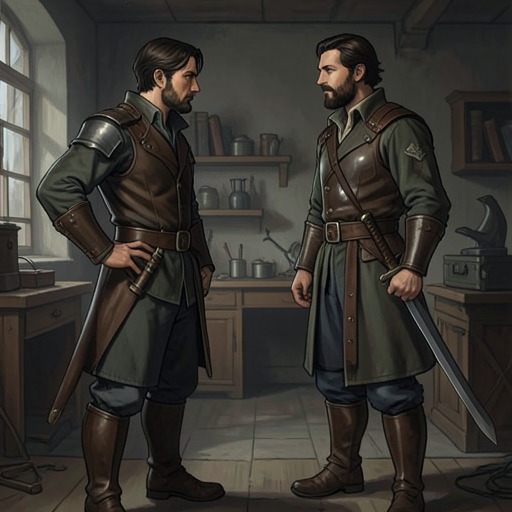
Matt and Borka’s relationship
Ronja, the Robber's DaughterMatt and Borka’s relationship is transformed from a feud between rival robber chiefs into a brotherhood sealed by combat, shared rule, and a feast in Matt’s Fort. The change is neither a simple surrender nor a complete end to conflict: Matt becomes the acknowledged chief, while Borka keeps his title and his men, and their eventual hopes for succession are unsettled by Ronia’s refusal to inherit her father’s calling.
Inherited Rivalry and Competing Claims
The conflict between Matt and Borka is tied to family inheritance as well as territory. Matt presents his robber chieftaincy as a legacy carried by his father, grandfather, and great-grandfather, and expects Ronia to follow him. Her rejection makes the moral distance between them plain: she objects not only to the title but to taking other people’s property, insisting that she will not remain Matt’s daughter if he robs people. Matt’s appeal to tradition and his claim that he takes only from the rich cannot settle the disagreement.
The rival bands’ hostility has practical consequences beyond the two chiefs. While Matt tries to understand what Borka’s robbers are doing in the North Fort, the routes through the woods grow unusually quiet. The Sheriff’s men find Borka’s former den deserted and leave Borka’s Wood, while Matt continues to scout the northern side of his own territory. His attempt to rush Borka’s guarded rope ladder ends in a failed assault: arrows drive Matt and his men back, and Little-Snip is injured. The rivalry is therefore maintained both by competing claims and by the dangers of approaching the other band’s stronghold.
Their feud also reaches into their families. When Matt holds Birk, Borka condemns him for using a child to get what he wants and calls the act vile. The exchange shows that their antagonism does not eliminate a shared understanding of parental obligation: Borka objects to Matt’s treatment of his son, while Matt’s own expectations of Ronia have already made fatherhood inseparable from the future of his band.
The Threat That Makes Cooperation Possible
The turn comes when Borka rides to the Wolf’s Neck with news of an ambush on Robbers’ Walk. The Sheriff’s men have captured two of Borka’s robbers, and a third has been wounded while trying to escape. Borka warns Matt that the woods are dangerous for any robber who values his life. Although the two men remain archenemies, Borka frames the warning as repayment for Matt’s recent rescue of two of his men from the sheriff’s dungeon.
Matt’s response reveals a change before he has consciously accepted one. He says that the sheriff’s men must be taught to behave and that “we” cannot allow this to continue. Only afterward does he notice that he has spoken as if the two bands already shared a cause. He pauses, looks Borka over, and proposes that they join forces, despite his discomfort at making such a suggestion to a Borka.
Borka welcomes the practical prospect of one strong band, but immediately contests who should lead it. He suggests himself as the strong and resourceful chief; Matt answers with laughter and a challenge. The alliance therefore begins not with agreement about authority but with a decision to settle the question openly. Noddle-Pete’s earlier proposal of single combat has provided the model: the fight is meant to establish Borka’s place and make him more amenable, while bringing both bands under one chief.
Combat and the Settlement of Authority
The combat follows the robbers’ rules for a wild beasts’ match, in which almost every trick and hold is permitted, but a foul blow between the legs means immediate defeat. These customs offer an internal means of deciding leadership outside the Sheriff’s authority. They do not abolish force; instead, they regulate it and make its result binding on the rival bands.
Matt wins. He emerges as chief, and the assembled robbers accept his standing, though the outcome is a sorrowful one for some of them, especially Borka. Matt then defines the terms of their new relationship. He calls Borka his brother, says that Borka will retain a chieftain’s name and reputation and may continue with his own men, but makes clear that Matt is now the mightier chief and that his word carries greater weight. The settlement preserves Borka’s identity and authority within his band while placing the united organization under Matt.
The Feast, Shared Memory, and Unresolved Succession
That evening, Matt hosts a feast in the stone hall for both groups. As the meal and beer continue, the former rivals sit side by side, alternately laughing and crying as they recall childhood escapades, including hunting rats together in an old pigsty. Their remembered past complicates the feud: they have not always been enemies, and the public recognition of a shared childhood gives their new brotherhood a history deeper than the day’s victory.
Ronia and Birk sit at the far end of the table and enjoy the stories. Their laughter rises above the robbers’ voices, a sound Matt and Borka have missed while the children were away. The feast thus joins political settlement to family reunion: the bands share a hall, the chiefs recover their childhood bond, and the children’s presence makes the return to Matt’s Fort feel like a renewed household as well as a merger of forces.
Matt then tells Borka not to be discouraged by losing, since Borka’s son might become chief after the older men are gone. He reasons that Ronia will not take the position because she has refused it, attributing her resolve to her mother. Borka is delighted by the prospect, but Ronia immediately challenges the assumption that Birk wants to become a robber chief. Her objection leaves the new order’s future open: Matt and Borka have settled their own leadership dispute, but their children have not agreed to inherit the world that produced it.
Significance
The relationship’s change is marked by a shift from inherited opposition to chosen cooperation, but it does not make the two men equal in power or erase their robber identity. Their alliance answers the immediate danger posed by the Sheriff’s men, and the fight supplies a recognized way to settle leadership; the feast, by contrast, restores intimacy through memory and family presence. Together, these outcomes show how formal authority, group custom, and personal ties can coexist without becoming the same thing.
Ronia’s repeated refusal to become a robber chief also places a limit on the reconciliation. Matt and Borka can call one another brothers and combine their bands, but their children’s futures cannot simply be assigned by tradition or by the settlement between the fathers. Their new brotherhood resolves the contest over who leads; it does not resolve whether the next generation should continue the robbers’ way of life.